LOCAL SOIL CARE IN HERNANDO
DeSoto Turf provides lime treatment services in Hernando, MS, as part of our eight-treatment lawn care program. Our final annual visit includes a granular lime application intended to help manage soil acidity and support the conditions grass needs to use available nutrients.
Hernando lawns can have very different soil conditions, even within the same neighborhood. Some properties have clay-influenced ground, while others contain loam, disturbed construction soil, or a mixture of materials brought in during landscaping.
These differences matter because soil pH affects how nutrients behave in the ground.
Lime is not fertilizer, and it will not make dormant grass turn green overnight. It works gradually by raising soil pH when the soil is too acidic.
Our service pros consider the lawn’s condition, grass type, and soil needs when discussing lime treatment.
BUILT FOR HERNANDO SOIL
Lime changes soil chemistry over time. Its main purpose is to raise pH in soil that is more acidic than the grass requires.
It does not directly kill weeds, loosen compacted ground, or replace a balanced fertilizer program.
Agricultural lime commonly contains calcium carbonate or a related liming material.
When applied to acidic soil, it reacts gradually and helps neutralize acidity.
The amount needed depends on the soil’s current pH, buffering capacity, and the type of lime used.
Applying more lime than necessary can raise pH too far.
Soil pH affects how readily grass can use nutrients such as phosphorus and several micronutrients.
Correcting excessive acidity may improve nutrient availability.
This does not add all the nutrients a lawn needs. Fertilization remains a separate part of lawn care.
Roots perform best when the soil provides suitable moisture, air, nutrients, and chemical conditions.
Excessively acidic soil can interfere with normal growth.
Where acidity is a limiting problem, correcting pH can help create a better environment for roots.
Lime will not repair roots damaged by insects, disease, or prolonged waterlogging.
Granular lime does not dissolve and change soil pH immediately.
Its reaction depends on particle size, soil moisture, the liming material, and contact with the soil.
Changes may take months, particularly when lime remains on the surface.
Our lawn care program includes fertilizer during active grass growth and granular lime during the final annual treatment.
These applications serve different purposes.
Fertilizer supplies nutrients, while lime is used to manage soil acidity.
Our lawn care services follow the growing season rather than relying on one product to address every soil problem.
THE LIME TREATMENT PROCESS
Our eight-treatment program includes granular lime during the final round, normally scheduled from late November through December.
The application is part of the yearly lawn care schedule, with attention to the condition of the property and the treatment being applied.
Our service pros look at the grass and note areas that appear thin, discolored, or stressed.
We also consider whether the symptoms may be related to drainage, compaction, or another lawn problem.
Grass appearance alone cannot confirm soil acidity.
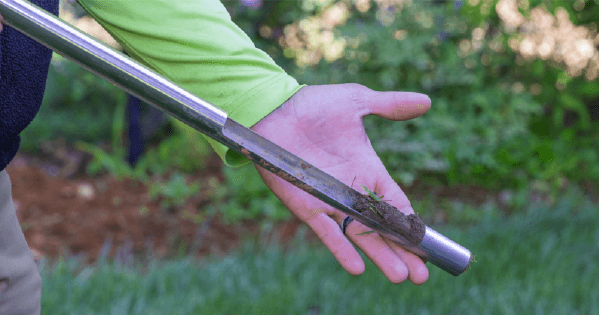
If soil test results are available, they provide useful information about the lawn's pH and lime requirements.
Soil tests can also help prevent unnecessary applications.
The amount of lime needed is not determined simply by how brown or yellow the grass looks.
We consider recent rainfall, soil moisture, and the condition of the lawn.
Granular lime is generally applied with spreading equipment.
Very wet ground may be unsuitable for equipment traffic, particularly where the soil is already compacted.
Our service pros distribute the selected granular material according to the treatment plan and product directions.
Even coverage matters because excessive application in one area can produce uneven soil conditions.
The material remains on the soil surface initially and reacts gradually.
Our final annual treatment also includes spot treatment for remaining weeds where conditions allow.
The weed-control application and lime serve different purposes.
We follow the relevant instructions for each product.
After the visit, we explain whether watering is needed and what to expect from the application.
Lime does not produce the immediate response associated with some fertilizers.
We also discuss any lawn conditions that may need attention outside the regular treatment schedule.
AFTER YOUR LIME TREATMENT
Granular lime needs time and moisture to react with the soil.
The exact aftercare depends on the material used and whether another treatment was applied during the same visit.
Our service pros provide instructions for your lawn.
In general:
Hernando can receive substantial rainfall during the cooler months.
On sloped properties, heavy runoff may move surface-applied materials away from the intended area.
Watering should help the treatment without creating unnecessary runoff.
WHAT RESULTS LOOK LIKE
Lime works slowly.
You should not expect the lawn to change color immediately after application.
The material must react with the soil before it can meaningfully change pH.
The response depends on the type and fineness of the lime, soil moisture, existing acidity, and soil buffering capacity.
Some changes may begin within weeks, but a meaningful adjustment can take several months or longer.
If the grass is dormant when lime is applied, visible growth will also be limited until the next growing season.
Even then, improved grass color does not prove that lime caused the change.
Seasonal green-up, fertilizer, rainfall, and warmer temperatures can all affect appearance.
The most dependable way to assess pH correction is through follow-up soil testing at an appropriate interval.
HERNANDO SOIL AND GRASS
Hernando properties can contain clay- and loam-influenced soils, with considerable variation caused by grading and development.
The City of Hernando’s comprehensive planning information identifies local soil groups that include Memphis-Loring and Grenada-Calloway.
These soil groups contain different horizons and textures.
A homeowner may also have imported topsoil, fill material, or heavily disturbed ground that behaves differently from the surrounding natural soil.
Soil texture matters because it influences how the ground holds water and responds to amendments.
Clay-rich soils often have greater buffering capacity than sandy soils. That means they may require more liming material to achieve a similar pH change.
However, texture alone does not tell us whether lime is needed.
A clay lawn can have suitable pH, while a different soil may be too acidic or too alkaline.
Bermudagrass and zoysiagrass are common warm-season grasses in Hernando.
Both can grow across a range of soil conditions, but their performance still depends on appropriate pH, sunlight, moisture, and nutrients.
Mississippi State University Extension provides information on selecting lawn grass for different growing conditions.
Our service pros consider grass type and soil conditions when discussing lawn care.
LIME AND OTHER LAWN PROBLEMS
Lime is appropriate when soil testing indicates that pH needs to be raised.
The amount depends on the soil’s acidity and buffering capacity.
Adding lime without knowing the soil condition can create an imbalance.
Yellowing grass may result from nutrient deficiencies, seasonal dormancy, poor drainage, disease, or insect activity.
Lime can help only when excessive soil acidity is contributing to the problem.
We look for other causes rather than assuming discoloration means the lawn needs lime.
Lime does not physically loosen compacted soil.
If grass roots are struggling because the ground is tightly packed, mechanical core aeration may be more suitable.
Soil pH correction and compaction relief are separate treatments.
A lawn that remains wet after rainfall may have grading, soil structure, or drainage problems.
Lime will not redirect water or repair a low area.
The cause of the drainage issue needs to be identified.
Fertilizer provides nutrients, but applying more fertilizer is not always the answer to weak grass.
If soil pH is unsuitable, certain nutrients may be less available.
A soil test helps determine whether the lawn needs fertilizer, lime, or another correction.
THE DESOTO TURF DIFFERENCE
DeSoto Turf is based in Hernando, and our lawn care program is built around the seasonal changes local grass experiences.
Our final annual treatment includes granular lime as part of the eight-visit schedule.
We also understand that lime is not a quick fix for every lawn problem.
Our approach includes:
We use different treatments for different purposes.
Our weed control and fertilization program includes preventive weed treatments, seasonal fertilizer, and the final lime application.
If a lawn has compaction, irrigation trouble, or insect damage, we explain why those conditions may need separate attention.
COMMON HERNANDO LIME QUESTIONS
A healthy lawn needs more than regular mowing and fertilizer. The soil must also provide suitable conditions for roots to use water and nutrients.
At DeSoto Turf, our eight-treatment program includes granular lime during the final annual visit, along with seasonal weed prevention and fertilization throughout the growing season.
Our service pros can also help you recognize when compaction, drainage, or another issue may be affecting the grass.
If you have questions about soil pH, lime treatment, or the condition of your Hernando lawn, contact DeSoto Turf. We can discuss your lawn and explain how our seasonal treatment program works.